

Why 2-Stroke Engines Still Matter for UAVs in the Electric and Hybrid Era
In today’s UAV discourse, internal combustion engines — and especially 2-stroke engines — are often portrayed as a fading technology. Electric and hybrid solutions dominate conferences and headlines. However, when UAV platforms are analyzed from a system-level and operational perspective rather than through trends, a different picture emerges.
Even in 2026, no alternative offers the same combination of specific power, energy density, operational simplicity, and endurance as a properly designed 2-stroke engine dedicated to UAV applications.
The engine is part of the system, not a standalone metric
In UAVs, the engine directly affects endurance, thermal envelope, energy management, system availability, and field maintenance. Designing an engine around nominal power figures alone ignores its interaction with the full platform.
The 2-stroke architecture enables stable operation across wide RPM ranges, rapid response to load changes, and a minimal number of moving parts — key advantages for platforms operating under variable mission profiles and off-design conditions.
Operational experience as the foundation of design
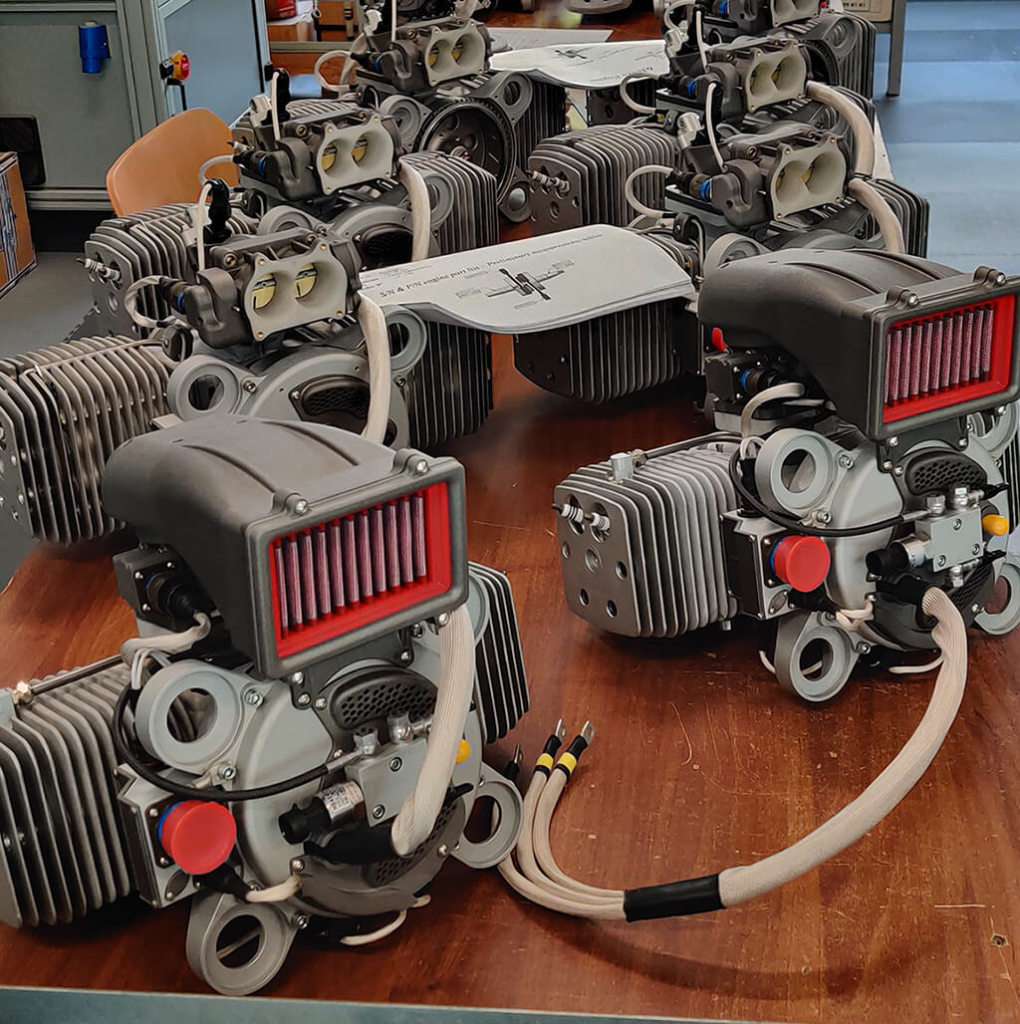
Zanzottera designs and manufactures UAV engines ranging from 58 cc to 1000 cc. All models feature EFI, air cooling, and support both MOGAS and AVGAS, with dedicated heavy-fuel variants for selected platforms. These engines have accumulated long-term operational experience worldwide, across diverse missions and environmental conditions.
This experience directly informs design decisions, material selection, operating margins, and derating strategies.
Endurance is not a theoretical number
A critical distinction between an engine that “runs” and one suitable for operational UAV use is how endurance is validated. Zanzottera works closely with customers to define and execute endurance test campaigns based on the actual mission profile of each platform, including realistic loads, altitudes, RPM regimes, and duty cycles.
This approach exposes real system limitations early and ensures the engine is optimized for operational reality rather than laboratory conditions.
Environmental testing as a design input
UAV engines do not operate in controlled environments. Engine components and subsystems are therefore evaluated under demanding environmental test conditions aligned with MIL-STD-810 methodologies, including temperature extremes, vibration, humidity, dust, and other relevant factors.
These tests are not treated as formal validation steps alone, but as engineering tools that feed back into design refinement.
Operational simplicity and maintainability
Most UAV systems are operated and maintained by system technicians rather than engine specialists. Maintainability, accessibility, and reduced maintenance time are therefore fundamental design drivers.
A well-designed 2-stroke engine enables straightforward maintenance, clear fault diagnosis, and high system availability throughout its service life.
Hybrid architectures, VTOL, and power generation
Hybrid solutions are increasingly common, particularly in VTOL platforms. In such architectures, the internal combustion engine serves as a stable power source for high-output alternators, charging batteries and supporting system-level energy management.
Here, the predictability, low mass, and simplicity of a 2-stroke engine allow complexity to be addressed at the system level rather than within the engine itself.
Quality as an industrial foundation
All development, manufacturing, and testing activities at Zanzottera are conducted within a rigorous and controlled quality management system compliant with ISO 9001. Quality is not treated as a formal requirement, but as a framework for consistency, traceability, and continuous improvement across the product lifecycle.
Conclusion
2-stroke engines remain relevant in the UAV domain not because they are simple, but because they enable correct system-level design — starting from the mission, validated under realistic conditions, and proven through long-term operational use.
Engineers who design UAVs with operational understanding rather than theoretical assumptions know when this remains the right solution.

